Computer Vision Quality Inspection for Manufacturing SMEs
A pragmatic guide for mid-sized manufacturers weighing automated visual inspection: when it pays off, what data and hardware you need, and how to run a pilot that survives contact with your production line.
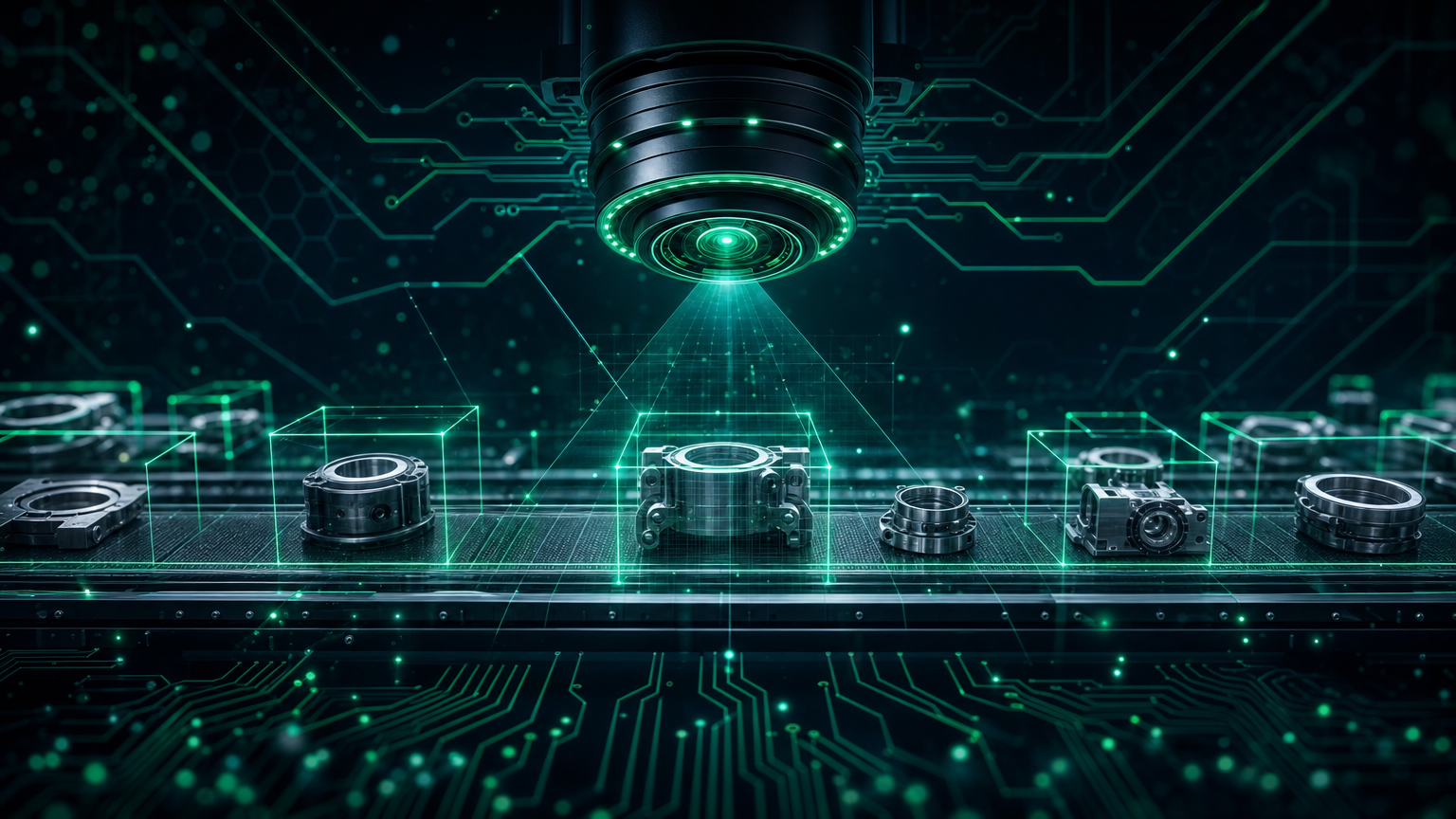
Computer vision for quality inspection is one of the few AI use cases on the factory floor with a genuinely clear payback story. A camera, a model, and a reject signal can catch defects that a tired human eye misses at 2 a.m. But the gap between a convincing demo and a system that runs unattended for three shifts a day is enormous. This guide is written for operations, quality, and digital transformation leaders at mid-sized manufacturers who want to know whether visual inspection is worth automating on their line, and how to avoid the expensive mistakes that sink most first projects.
We work primarily with manufacturing AI projects in and around Munich, and the pattern is consistent: the technology is rarely the bottleneck. The bottleneck is choosing the right station, getting clean labelled images, and integrating cleanly with the equipment you already run. Let us walk through it honestly, including the cases where you should not automate at all.
1. When visual inspection is worth automating
Automated inspection earns its keep when the defect is visually distinguishable, the inspection is repetitive, and the cost of a missed or false reject is high. Good candidates share a few traits:
- High volume, manual 100% inspection. If a person is staring at every part, you are paying a recurring labour cost and accepting human fatigue. That is exactly where a camera shines.
- Defects with a visual signature. Scratches, missing components, weld porosity, surface contamination, label and print errors, fill levels, dimensional gross-checks. If a trained operator can see it, a model usually can too.
- Stable presentation. The part arrives in a roughly repeatable position and orientation, or can be fixtured to do so.
- A meaningful cost of escape. A defect that reaches the customer triggers a recall, warranty claim, or line stoppage downstream.
When NOT to automate. Be honest about the poor fits. If your defect rate is already extremely low and the defects are rare and varied, you will struggle to gather enough examples to train anything reliable, and a classical rule-based vision tool or a skilled inspector may be both cheaper and better. If the defect is essentially invisible in a 2D image, no model will conjure it. If your product mix changes weekly with no shared visual grammar, the cost of re-training and re-validating can outrun the benefit. And if the inspection is genuinely a judgement call that even your experts disagree on, you have a labelling problem, not an automation opportunity.
2. What data you need
Vision projects live or die on data, and SMEs routinely underestimate this. You need representative images of both good parts and the defects you care about, captured under the lighting and optics you intend to deploy. A few practical points:
- Defect examples are the scarce resource. Good parts are easy; you make thousands a day. The defects are rare by design. Start collecting and archiving defect images now, even before a project begins, with the defect type recorded.
- Label quality beats label quantity. A few hundred carefully and consistently labelled images often outperform thousands of sloppy ones. Agree a written defect taxonomy with your quality team first.
- Capture the real variation. Different batches, suppliers, shifts, and times of day introduce variation in colour, gloss, and contamination. Your training set must reflect that range or the model will fail the first time conditions drift.
- Consider augmentation and synthetic data carefully. For some defect classes you can generate variations, but synthetic data is a supplement, not a substitute for real examples of your actual failure modes.
If you cannot yet say how many labelled defect images you have per category, that is the first thing to fix. An AI Readiness Audit typically starts here, because data availability determines whether a pilot is even feasible this quarter or next year.
3. Common failure modes
Most vision deployments fail in predictable ways. Knowing them in advance lets you design around them:
- Lighting drift. A model trained under one lighting condition degrades silently when ambient light changes, a bulb ages, or a window lets in afternoon sun. Controlled, enclosed lighting is non-negotiable.
- Distribution shift. A new supplier, a tweaked process, or a different material finish changes the images. The model has no way to know the world moved. You need monitoring that flags when inputs look unfamiliar.
- Class imbalance. With defects at a fraction of a percent, a model that simply says "good" every time looks accurate and is useless. Measure the things that matter: catch rate on real defects and false-reject rate, not headline accuracy.
- The demo trap. A model that scores well on a curated test set can collapse on the line because the test set never contained the messy, borderline, partially occluded parts that production produces.
- No human-in-the-loop path. Without a clear route for operators to review borderline calls and feed corrections back, the system cannot improve and trust erodes.
4. Build vs buy
There is no universal answer; there is a decision that fits your situation.
Buy (or use a platform) when your inspection is a reasonably standard problem, you want predictable support, and you would rather pay a licence than staff an internal vision team. Off-the-shelf smart cameras and inspection platforms have matured a great deal and handle a large share of common surface and presence-absence checks with configuration rather than custom code. For many SMEs this is the right starting point.
Build (custom) when your defect is unusual, your integration requirements are specific, your data is genuinely proprietary and differentiating, or you have several inspection stations that justify a shared in-house capability. Custom gives you control and avoids per-seat licence creep, but it commits you to owning the model lifecycle: retraining, monitoring, and validation.
A pragmatic middle path is common: buy the camera and edge hardware, use an established framework, and invest your custom effort only in the model and the integration glue that is specific to your line. Avoid building infrastructure that a vendor already does well; spend your scarce engineering time on the part that is actually unique to you.
5. Pilot design
Treat the pilot as an experiment with a written hypothesis, not a procurement. A well-scoped pilot answers one question: can this catch our defects on our line at an acceptable false-reject rate? Structure it like this:
- Pick one station and one defect family. Resist the urge to solve everything. Choose the inspection with the clearest economics and the best available data.
- Run shadow mode first. Let the system make predictions alongside your existing process without acting on them. Compare its calls to human inspectors before you give it any authority to reject parts.
- Define acceptance criteria up front. Decide before you start what catch rate and false-reject rate constitute success, agreed with quality. Moving the goalposts afterwards is how pilots drag on forever.
- Set a time box. Six to twelve weeks is usually enough to learn whether the approach works. If it is not converging, that is a valid and cheap result.
- Plan the feedback loop from day one. Operators need a fast way to mark disagreements so the model and the team learn together.
6. ROI metrics (qualitative)
Resist the temptation to lead with a percentage you cannot defend. Build the business case from the levers that actually move on your line, and quantify them with your own numbers:
- Cost of escaped defects avoided. Warranty, recall, scrap-at-customer, and reputational cost of defects that currently slip through.
- Inspection labour redeployed. Hours of manual 100% inspection that can shift to higher-value work, rather than headcount cuts.
- Throughput and consistency. A camera does not get tired at the end of a shift, so quality is more uniform across shifts and operators.
- Earlier detection. Catching a process drift at the inspection station before it produces a whole bad batch is often the largest hidden saving.
- The cost side, honestly. Hardware, integration, validation, and the ongoing cost of retraining and monitoring. A system that needs constant babysitting can erase its own benefit.
7. Deployment constraints
This is where promising pilots meet hard reality. The model is the easy part; deploying it into a live line is the work.
- Lighting. The single most decisive factor. Enclose the inspection point, control the light source, and standardise it. Consistent, defect-revealing illumination often matters more than the model architecture.
- Line speed. The system has a fixed time budget per part. Image capture, inference, and the reject decision must all fit inside the cycle time at full production speed, not at the relaxed pace of a demo.
- Edge hardware. Many lines cannot tolerate a round trip to a cloud server for latency, reliability, or data-policy reasons. Inference often has to run on an industrial edge device near the camera, which constrains the model size and the framework you can use.
- Integration with PLC and MES. A reject decision is only useful if it triggers an action. That means a clean digital handshake with the PLC to actuate a reject mechanism, and reporting back into the MES so defect data is logged, traceable, and visible alongside the rest of your quality records. This integration work is routinely underestimated and is where you most want an experienced partner.
- Maintenance and ownership. Cameras drift, lenses get dirty, and processes change. Someone must own recalibration, retraining, and monitoring. Decide who, before you go live.
None of this is exotic, but all of it has to be right at once. The teams that succeed treat vision inspection as a manufacturing engineering project with an AI component, not an AI project that happens to live on a factory floor. Treating it the other way round is one of the five mistakes companies make integrating AI.
Where to start
Two earlier pieces are worth reading alongside this one: how to know if your business is ready for AI covers the data and process foundations a vision pilot assumes, and what to expect from machine learning ROI gives realistic ranges for quality inspection returns.
If you have one inspection station that hurts, defect images in a folder, and a quality team that can agree on what a defect is, you are closer than most. The right first move is not to buy a camera. It is to confirm that vision inspection is genuinely your highest-return pilot before any hardware budget is committed.
Frequently asked questions
How many defect images do you need to train an inspection model?
Fewer than expected for the defect classes you see often, more than expected for the rare ones. A few hundred examples per defect type is a workable starting point. The harder constraint is coverage: every lighting condition, product variant, and camera position you will meet in production needs representation.
What if we do not have images of defects because they are rare?
Then approach it as anomaly detection rather than classification. Train on what good looks like and flag deviations. This trades precision for coverage, produces more false alarms, and still often beats manual sampling on a line where defects escape today.
Does automated inspection replace the quality inspector?
Rarely, and framing it that way tends to sink the project. The realistic outcome is that the system handles the high-volume routine checks and escalates the ambiguous cases, which lets inspectors spend their time where judgement actually matters.
Will the model still work after we change the product or the line?
Not automatically. A new variant, a different supplier's material, a repositioned camera, or new lighting can all degrade performance quietly. Plan for periodic revalidation and a way to detect drift, and treat any physical change to the cell as a trigger to check the model.
Is automated inspection right for your line?
A Manufacturing AI Readiness Audit identifies whether vision inspection is your highest-ROI first pilot, before you buy hardware or tools.
Book a Manufacturing AI Readiness AuditSitnik AI
Applied AI consultancy for healthcare and manufacturing teams. Led by a PhD computer scientist and former CTO, with research in medical imaging and production AI systems.